
-
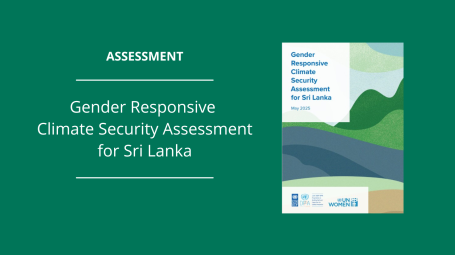
Gender Responsive Climate Security Assessment for Sri Lanka
Commissioned by the UNDP–DPPA Joint Programme and UN Women with the support from the Government of Australia, and conducted by adelphi research, this pioneering assessment offers the first integrated analysis of climate resilience, peacebuilding, and gender dynamics in Sri Lanka. The report provides actionable insights and locally tailored recommendations to support inclusive governance, equitable climate adaptation, and strengthened social cohesion. -
Gendered and Ethnic Climate Security Risks in Sri Lanka: Concrete Realities and Politically Smart Solutions
This policy brief, based on the Gender Responsive Climate Security Assessment for Sri Lanka, examines how climate change is intensifying vulnerabilities and deepening inequalities in Sri Lanka, particularly for women and marginalised ethnic groups in post-conflict areas. Drawing on recent fieldwork and lived experiences of communities in Batticaloa, Mullaitivu, Badulla, and Hambantota districts, it offers concrete examples and politically realistic recommendations for inclusive, conflict-sensitive climate adaptation. -
Gender Responsive Climate, Peace and Resilience: Climate Opportunities for Peace and a Unified Sri Lanka
This policy brief, based on the Gender Responsive Climate Security Assessment for Sri Lanka, examines how embedding justice and equity in climate action can address underlying grievances, strengthen social cohesion, and prevent the re-emergence of conflict in Sri Lanka. It offers gender-responsive and conflict-sensitive recommendations to advance inclusive climate adaptation, peacebuilding, and national unity. -
Climate Impact Profile: Sri Lanka
Sri Lanka is particularly vulnerable to the impacts of climate change. This profile provides an overview of climate trends for short-term (2020-39) and medium-term time periods under both higher emissions (SSP3-7.0) and lower-emission (SSP1-2.6) scenarios and their impacts across different sectors.



