

Shared Waters, Shared Futures: How regional organisations are strengthening maritime cooperation in the Bay of Bengal
From shared principles for maritime conduct to a network of marine scientists, regional organisations are translating years of dialogue into concrete action.
The Bay of Bengal is one of the most consequential bodies of water on earth. Home to over a billion people across its littoral states (Bangladesh, India, Indonesia, Malaysia, Myanmar, Sri Lanka and Thailand), it sustains fishing communities and serves as a vital maritime route driving regional trade. At the centre of some of the world’s most severe climate and disaster risks, including cyclones, flooding and sea-level rise, the Bay of Bengal is also a region where cross-border cooperation on shared maritime challenges has historically taken time to build. Coordinated regional governance is essential. It allows littoral states to jointly manage marine resources, secures coastal livelihoods and keeps trade flowing smoothly across shared waters.
Over the past five years, the Bay of Bengal Maritime Dialogue, facilitated by the Centre for Humanitarian Dialogue (HD), has brought together policymakers, scientists and experts from the region to work through complex issues, from maritime security to marine environmental governance, in a structured, neutral setting. The key mission of the dialogue is to provide a space for the littoral states and regional organisations to develop a shared understanding of the maritime challenges they face and advance concrete initiatives for regional cooperation from there.
Three of those initiatives stand out as significant achievements for the region, showing what trust-based collaboration between states, supported by a sustained platform for dialogue, can deliver: (1) common norms for conduct at sea, (2) a shared scientific network for marine research and (3) a regional framework for disaster response.
Common norms for conduct at sea
Encounters between maritime law enforcement vessels and fishing vessels from different nations carry real risk without shared norms or common rules. Maritime interactions can produce misunderstandings and escalate rapidly, potentially resulting in physical clashes, detentions or asset confiscations, which could lead to diplomatic friction. Establishing agreed norms of conduct is therefore more than a procedural matter. It is a prerequisite for regional trust, which is vital to ensuring effective coordination and fostering better linkages among law enforcement agencies.
Guiding Principles
In July 2026, BIMSTEC Member States endorsed a set of Guiding Principles on the Conduct of Maritime Law Enforcement Agencies during Interactions at Sea. These principles establish baseline operating guidelines for MLEAs during encounters at sea in the Bay of Bengal region, covering aspects of communication and response. These principles provide important reference to MLEAs and ensure better predictability and safety in maritime interactions.2
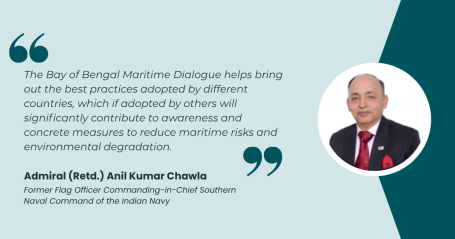
In 2022, a table-top exercise hosted by HD, in partnership with the United Service Institution of India in New Delhi, brought together representatives of maritime law enforcement agencies (MLEAs) from the Bay of Bengal region. The exercise identified gaps in how agencies from different countries communicate and share information and demonstrated the need for a collaborative approach to address shared maritime threats. Under the leadership of the BIMSTEC Expert Group on Maritime Security Cooperation, member states took that insight forward to formulate the BIMSTEC Guiding Principles on the Conduct of Maritime Law Enforcement Agencies during Interactions at Sea.1 The Guiding Principles set out agreed norms for maritime conduct and represent a meaningful step towards greater predictability and de-escalation in a strategically important region.
Science as a foundation for regional governance
The Bay of Bengal’s marine environment is under serious stress. Declining fish stocks and eroding coastal ecosystems require a shared understanding of these challenges before coordinated action is possible. However, the scientific communities of the littoral states previously had few formal mechanisms to work together.
In February 2023, HD co-hosted a marine scientific dialogue with the Bay of Bengal Programme (BOBP-IGO) in Kochi, India. The dialogue produced the Kochi Declaration on Marine Science Cooperation, which called for the establishment of a regional research network under the aegis of BOBP-IGO.3 BOBP-IGO and India’s Ministry of External Affairs took the initiative forward, establishing the BIMSTEC-India Marine Research Network (BIMReN).4
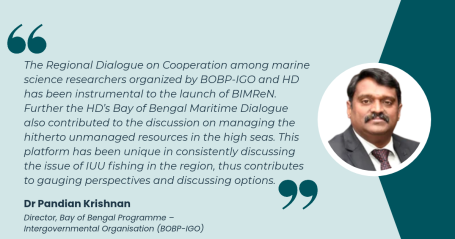
BIMReN is a platform that has connected over 50 research institutions and 25 institutes across five BIMSTEC countries. BIMReN has contributed to bringing regional researchers together towards addressing the key regional challenges, including marine pollution and major threats to coastal livelihoods in the Bay of Bengal region.
Preparing the region for the next disaster
Disasters do not respect maritime boundaries. When a major cyclone or flood strikes the Bay of Bengal, the ability of neighbouring countries to coordinate their response can determine the scale of humanitarian impact. Through sustained engagement in the Bay of Bengal Maritime Dialogue, Humanitarian Assistance and Disaster Relief (HADR) emerged as one of the most consistently identified areas where deeper regional cooperation is both urgent and achievable. BIMSTEC member states shared this understanding and recently developed and adopted the Guidelines for the Maritime Component of Humanitarian Assistance and Disaster Relief,5 which represent a formal institutional commitment to coordinated response at sea.
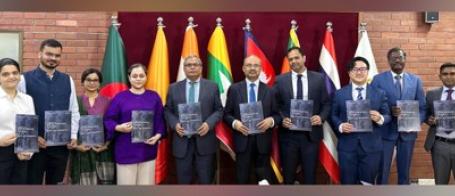
Report launch event at the BIMSTEC Secretariat, Dhaka, 8 July 2025 (Photo by BIMSTEC Secretariat)
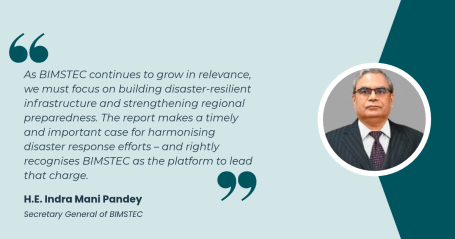
Building on this, a policy workshop convened by the BIMSTEC Secretariat, the Institute of Peace and Conflict Studies (IPCS) and HD in 2024 produced the report Harmonising Humanitarian Assistance/Disaster Relief in the Bay of Bengal.6 Launched at the BIMSTEC Secretariat in Dhaka in July 2025, the report calls for unified climate disaster mapping and shared crisis communications platforms. These are practical steps that would strengthen the region’s collective resilience, especially with the establishment of the new BIMSTEC Centre of Excellence for Disaster Management in the future.
A potential template for the wider region
These achievements show what becomes possible when regional institutions have a sustained, trusted space to work on difficult issues. The Bay of Bengal Maritime Dialogue has demonstrated that a carefully facilitated platform – one that gives states the room to identify shared challenges, build relationships and take ownership of solutions – can generate outcomes that no single actor could produce alone. The Guiding Principles, BIMReN, and the Humanitarian Assistance and Disaster Relief framework are not endpoints. They are foundations. As climate pressures intensify and the Bay of Bengal’s shared challenges grow more complex, the cooperative spirit and institutional commitments built through years of dialogue will matter more than ever. These achievements also show that the model of promoting trust-based collaboration between states through a sustained dialogue platform has a track record. Lessons from the Bay of Bengal Maritime Dialogue offer insights for the wider Indian Ocean and the Member States of the Indian Ocean Rim Association (IORA), where similar challenges could benefit from the same patient, regionally grounded approach.
1. NSCS of India Hosts 4th Expert Group Meeting on Maritime Cooperation. BIMSTEC Secretariat, 25 November 2026.
2. 5th Meeting of the BIMSTEC National Security Chiefs held in New Delhi, BIMSTEC Secretariat, 16 July 2026.
3. Kochi Declaration: A Resolution for Marine Science Cooperation in the Bay of Bengal Region. BOBP-IGO, 14 February 2023.
4. BIMSTEC-India Marine Research Network BIMReN Launched. BOBP-IGO, 23 February 2024.
5. 3rd Meeting of the BIMSTEC Expert Group on Maritime Security Cooperation. BIMSTEC Secretariat, 11 September 2024.
6. IPCS-BIMSTEC-HD Launch Report on Harmonising Humanitarian Assistance (HA) / Disaster Relief (DR) in Bay of Bengal. BIMSTEC Secretariat, 8 July 2025.
Share on