

How communities in Balad, Iraq are building climate resilience through shared water governance

Voting box during the WUA board election on 30 July 2025
Faced with growing water scarcity and rising tensions, farmers, tribal leaders, community representatives and local authorities came together in July 2025 to create Iraq’s largest Water Users Association (WUA). They listened to each other’s needs, grievances and, ideas and engaged in dialogue to better understand one another. They used this shared understanding to develop joint solutions to common challenges and activated the WUA as a locally led platform for fair water distribution, conflict prevention and inclusive decision-making — showing how dialogue and collaboration can turn climate pressure into collective action.
In the sub-district of Hatamiyah, Salah al-Din governorate, north of Baghdad, climate change is no longer an abstract concept. Shrinking water supplies and less predictable water allocations linked to declining water levels, shifting river channels and irregular upstream releases in the Tigris River, ageing and inefficient secondary canals, limited electricity for irrigation pumps, irregular rainfall and shifting agricultural patterns — including reduced harvests and declining crop yields — are reshaping the lives of farming communities. Newly emerged river-adjacent lands create disputes between landholders and farmers whose previously cultivated lands now lie farther from the river. This includes tensions over installing pumps, land concessions and passage through private agricultural spaces as well as increasing tensions across tribal lines. Left unaddressed, these dynamics risk escalating into wider disputes, weakening social cohesion and undermining community resilience.
Our engagement in Balad started with a simple premise: Listen first
Berghof Foundation and PPO convened and facilitated structured dialogue sessions that brought together community representatives, tribal leaders, and government officials to reflect on how climate-related pressures were affecting their daily lives. By providing a safe and inclusive space for exchange, participants developed a shared understanding and engaged in collective problem-solving. Building on individual experiences, participants explored how water scarcity had become a shared challenge requiring a collective response.
At first, participants simply exchanged their experiences and perspectives, listening to one another’s daily struggles. Through sustained engagement, trust was gradually built and space was created for all voices to be heard despite differing interests and internal tensions.
Our lands are dry – there is no water, and we don’t know what to do. No one is even willing to buy the lands because water cannot reach them.
– dialogue participant (translated from Arabic)
Deep dive: Water Users Association (WUA)
WUAs are legal platforms that are governed by bylaws, which must be adhered to in order to receive official support from government institutions. They are registered under the Ministry of Water Resources. Members consist of farmers who are willing to join, own a plot of land irrigated from the designated water source, and have a renewed contract with the agriculture department.
Gradually, the conversations shifted towards exploring the challenges they all faced together, uncovering how water shortages had become a common problem. By the end of the dialogue sessions, which spanned seven months, the group had moved from discussion to action, collectively deciding to activate a Water Users Association (WUA) as a legal platform for collaborative water governance and conflict prevention. It was adopted by tribal leaders, community representatives, and local authorities as a solution to a community-wide problem.
Building a local institution for shared water management
In July 2025, WUA board elections marked a major milestone. Representatives from certain irrigation canals were elected to form a 22-person board that represents 975 WUA members. What emerged was not just a new organisational structure, but a functioning institution with real authority and clear responsibilities: managing water distribution, mediating disputes, strengthening participatory decision-making and building trust across communities.
The WUA now supports fair allocation of water, maintains a comprehensive farmer database and introduces new tools for conflict resolution. For many in Balad, this marks a fundamental shift away from fragmented and informal responses towards a coordinated, transparent approach grounded in shared responsibility.
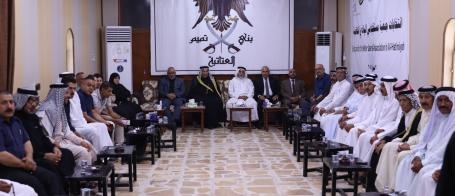
Election day for the WUA board, with participants convening at the tribal leaders’ venue in Al Hatamiyah, Balad
Inclusion across tribal lines
Hatamiyah is shaped by strong tribal dynamics, including long-standing inequalities between larger tribes like the Tamim tribe and historically marginalised groups such as the Qareh Gol tribe. From the outset, the WUA was designed with these inequalities in mind: an inclusive coordination mechanism that ensures participation across tribal groups, as members from these groups are now part of the WUA and its elected board. Including the Qareh Gol tribe in the dialogue process and establishment of the WUA has been particularly significant as it gives them an active role in shaping water governance, strengthens their relationships with other communities and tribes and helps reduce historical fragmentation and marginalisation.
Field observations indicate that the WUA has helped reduce inter-tribal tensions, broaden participation in local decision-making and foster collective ownership over water management challenges. By creating a neutral space for dialogue and cooperation, the WUA has contributed to rebuilding trust and strengthening social cohesion in a community facing additional strain from climate change.
Opening space for youth and women
The WUA has also become a platform for gradual social change. While traditional structures in Balad have historically limited the participation of youth and women, their inclusion in the dialogue process marks an important first step towards more inclusive governance.
Women’s leadership is beginning to gain visibility. A woman official from the Balad Water Resources Department led the WUA election process within the tribal guesthouse, traditionally used for hospitality, mediation, and community decision-making, signalling growing acceptance of women in public leadership roles. These shifts are still at an early stage and will require sustained engagement, but they signal that norms are evolving around participation and representation.
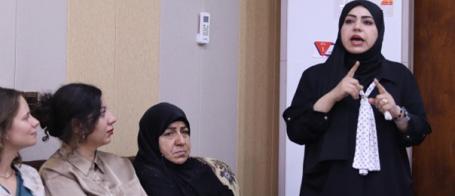
Water Directorate official facilitating WUA board election preparations in July 2025 at the tribal leaders’ venue
Looking ahead: A model for climate-sensitive governance
The establishment of Iraq’s largest Water Users Association in terms of participants and water users marks a broader transition from informal, traditional conflict resolution mechanisms towards structured and institutionalised governance. Close collaboration between the WUA and officials from the Ministry of Water Resources at both provincial and national levels helped overcome registration challenges and strengthened links between community-based initiatives and public institutions.
Today, the WUA in Balad stands as a living example of how tribal, legal and governance frameworks can align to address climate security risks. It offers a locally driven model for managing scarce resources, preventing conflict and building resilience. This can inform future policy engagement and replication in other climate-affected areas in Iraq.
What began as a response to water scarcity has grown into something larger: a shared process of cooperation, participation and trust-building. It shows what communities can achieve when they are supported with inclusive structures and dialogue. They can transform climate pressure into collective action.
Authors: Nike Löble, Shamim Al-Yabes, Ammar Zakri and Alexandra Steinkraus
Share on