

Bridging divides and tackling water scarcity: Community dialogue as a climate action in Iraq

Al Ayadiyah’s third dialogue session with mayors and committee members to sign the second agreement to reduce violations and activate the complaint mechanism, September 2024.
In Iraq’s Nineveh governorate, communities facing water scarcity didn’t just find practical solutions to improve water quality and availability for over 50,000 people, they found new ways to work together. Years of shrinking water supplies had fuelled tensions between neighbouring villages, sparking disputes over illegal tapping and unfair distribution that threatened to escalate into wider communal conflict. Facilitated dialogue helped residents of Al Ayadiyah and Tal Afar move from conflict to cooperation. In September 2023, they signed their first-ever community water agreement, pledging to protect shared resources and prevent violations. A year later, in October 2024, they signed another agreement which established committees to ensure fair distribution, accountability, and sustained cooperation. The process shows that climate action can foster both resilience and peace.
In the rolling plains of northern Iraq’s Nineveh governorate, the water that once nourished village life has become dangerously scarce. For the people of Al Ayadiyah and Tal Afar, climate change is no longer a distant concern; it is disrupting daily life. Years of rising temperatures and declining rainfall have put extreme pressure on natural and human-made water systems.
The Abu Maria water project, once a lifeline for twenty-four villages, has suffered from overuse, outdated infrastructure, and falling groundwater levels. As water levels in the Mosul Dam dropped to record lows, some villages were left with little or no water at all, fuelling tensions between neighbours and clashes with local authorities.
Dialogue as a Turning Point
Recognising the risks to deepening divides, a diverse group of local actors supported by the Berghof Foundation and Peace Paradigms Organisation (PPO), in partnership with the local government and the Directorate of Water launched a series of four community dialogues in Al Ayadiyah. For the first time, village elders, religious leaders, engineers, mayors, and security representatives came together to address the crisis. These sessions gave everyone a voice, allowing participants to map the root causes, share grievances, and co-design solutions.
The dialogues made it clear that managing the water system was a shared responsibility. This led to the first community water agreement, signed in September 2023, where all sides formally pledged to protect the resource together instead of relying solely on distant authorities. Tribal elders thus promised to stop illegal water tapping, residents agreed to report violations, and local officials committed to fair enforcement, issuing formal warnings, documenting infractions, and taking legal steps when needed.
“We had never sat together like this before.” As village mayor Barazan Salih put it: “To be honest, I had never attended sessions like these. This was the first time someone addressed the issue in such a direct and committed way. There were real problems between villages, each one blaming the other for tapping into the water line. But thankfully, with the support of the sub-district administration and through these sessions, we were able to move past that.”
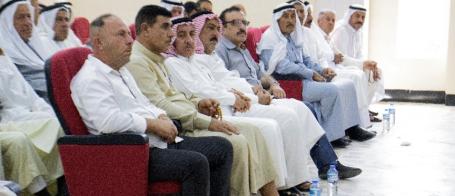
Al Ayadhiyah’s third dialogue session, September 2024.
Ownership, trust, and lasting impact
To maintain this momentum and as a result of the second agreement, a high-level local committee was formed in October 2024 and brought together key figures from government, public services, security bodies, and the wider community, including elders and religious leaders. This high group meets monthly to oversee the region’s water distribution schedule, respond to emergencies, and ensure the agreement is upheld. Emergencies range from exceeding water quotas and the conflicts that arise from them to broken and faulty water pipes. In such cases, the committees notify the water director, exert pressure to ensure action is taken, and follow up on the matter. Furthermore, the agreement stipulates the activation of a formal complaint mechanism.
Jassim Mohammed, the mayor of the village of Al Muthalatha, north of Iraq, noted: “Personally, these sessions improved how we deal with problems. They gave us climate-related dialogue mediation skills, helped us understand each other, manage disputes, and speak in a united voice on behalf of our communities. Before, water arrived late or not at all. Now, it flows more regularly. People feel responsible, because they helped shape the agreement.”
At the village level, small committees - compromising the mayor, the mosque imam, and a respected resident from each village - were established to address violations of the agreement and resolve local disputes. These committees recognised that such violations were harming the entire community and agreed on a clear plan: the mayor was tasked with raising awareness within the community and holding individuals accountable, while the Imam used the Friday sermon to emphasise the importance of prevention. This approach led to a significant reduction in violations. Under the new system, any violation was first addressed by the mayor; if no action was taken, the matter was escalated to the water director, ensuring a formal process of accountability.
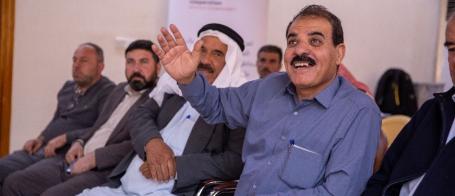
Al Ayadhiyah’s third dialogue session, September 2024.
From conversations to commitment
Alongside the second water agreement of September 2024, technical measures, such as repairing the Abu Maria water pump station, improved water access for over 50,000 people. But the most significant shift was cultural. Previously, water issues were discussed in isolated, informal meetings, with little coordination or follow-up. The dialogues broke down these barriers, bringing people together, and equipping participants with skills in mediation and dispute management. The new agreement formalised this collaboration and commitment, turning scattered frustrations into collective action. The impact of dialogue was immediate: after years of tensions, water disputes dropped sharply, and trust between villages began to grow.
The water crisis in Al Ayadiyah has not disappeared, but a new sense of shared responsibility and a culture of dialogue has taken root. Communities once divided by scarcity are now connected by a common vision, and trust is gradually being rebuilt through shared responsibility and dialogue. The water agreement is more than a local pact; it demonstrates how integrating climate and environmental security into peacebuilding efforts can lay the groundwork for lasting peace by addressing not just tensions, but the environmental pressures that often drive them.
The dialogue engagement and development of the agreement were initiated through the project "Enhancing Understanding and Supporting Local-Level Dialogue to Address Climate Security Risks in Iraq" (September 2022 – September 2023), kindly supported by the Robert Bosch Stiftung. Its strengthened implementation, follow-up, and institutionalisation were made possible through the subsequent project "Strengthening Iraqi Capacities to Respond to Climate Risks and their Impact on Existing Conflict Dynamics", led by the Berghof Foundation with support from the German Federal Foreign Office and is part of the Weathering Risk Peace Pillar led by adelphi, demonstrating how initial efforts were effectively built upon and scaled for greater impact.
This impact story was prepared by Nanor Bitar, Nike Löble (Berghof Foundation), Alina Viehoff, Alexandra Steinkraus (adelphi research) and Karrar Al Ibrahimi (Peace Paradigms Organisation).
Share on