

From Agreement to Action: How a Natural Resource Peace Agreement Is Supporting Peaceful and Resilient Communities in Nigeria’s Middle Belt

Award of Merit recognising HD peace efforts at the Igede Yam Festival
For decades, the Tiv and Igede communities in the Konshisha and Oju Local Government Areas (LGAs) in Benue State experienced recurring violent conflicts, with particularly serious incidents in 1997 and between 2020 and 2022. These conflicts resulted in hundreds of deaths, widespread displacement and severe economic and social disruption. Roads were blocked due to security risks, cutting community members off from vital services. Farm produce was destroyed, while markets and small businesses were forced to close. Meanwhile, the volatile security situation has enabled illicit economies, including excessive deforestation and sand mining, to flourish.
Contested access to and disputes around the use of natural resources, such as land for farming and herding, forests for hunting and woodcutting, streams and ponds, were at the heart of the conflict. These tensions have a long history, tracing back to colonial maps drawn in the 1920s and the lack of clearly delineated land boundaries between the two ethnic groups. Climate change has further exacerbated these longstanding tensions.
In recent years, climate change impacts, including droughts and irregular rainfall patterns, have reduced the availability of essential natural resources, such as arable land, in both LGAs. At the same time, population growth, over-exploitation of resources and migration from neighbouring areas have further intensified competition over limited resources, including land, forests and water points.
In November 2022, the Centre for Humanitarian Dialogue (HD) initiated an inclusive dialogue process involving traditional authorities, women, young people, religious leaders and community representatives. The process culminated in the signing of the Konshisha-Oju Natural Resource Peace Agreement in August 2023, marking a significant milestone in the pursuit of lasting peace and stability in the region. The agreement addresses access to and the shared management of water points, forests, farmland and markets, as well as the demarcation of contested boundaries. Its provisions also include specific commitments to climate adaptation and mitigating environmental degradation. A community peace committee is responsible for implementing and monitoring the natural resource peace agreement.
Since the agreement was signed, its implementation has brought visible improvements to peace, livelihoods and relationships between the Tiv and Igede communities. Violent clashes have declined significantly, allowing people to return to farming, trading and other daily activities. Natural resources are managed more collaboratively while community peace structures, working alongside traditional leaders, the Benue State Government and HD, continue to monitor the agreement, promote dialogue and resolve emerging issues before they escalate into violence.
These developments illustrate the value of linking climate, peace and security. By addressing the underlying drivers of conflict while helping communities adapt to environmental and climate pressures, the agreement strengthens community resilience to both climate change and the risk of future conflict.
Three examples show how implementation of the agreement is translating into tangible changes on the ground, from stronger livelihoods and renewed social cohesion to more collaborative management of shared natural resources.
- Infrastructure rehabilitation for stronger livelihoods – The Awajir Road rehabilitation
A significant step in implementing the Konshisha-Oju Natural Resource Peace Agreement is the rehabilitation of the Oju-Awajir Road, jointly funded by the Oju and Konshisha Local Governments with support from the Benue State Government. This initiative is a direct outcome of a key recommendation of the Konshisha–Oju Natural Resource Peace Agreement. Its launch involved formal consultations with key stakeholders, including the Chairmen of Konshisha, Oju, and Gwer East LGAs, traditional rulers from the Konshisha-Oju Peace Committee and Members of the Benue State House of Assembly representing the LGA constituencies. Since rehabilitation began in August 2025, farmers have found it easier to access their farms and transport produce to markets. This has increased trade, reduced transportation costs and travel time, improved household incomes and strengthened interaction between the neighbouring Tiv and Igede communities. The government, through the State Governor's sustained commitment, continues to support the road rehabilitation, which is expected to be replicated in neighbouring areas.
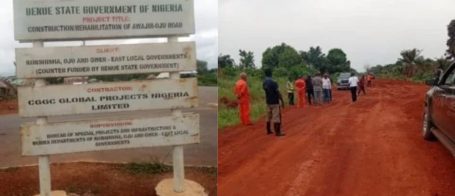
Oju-Awajir Road
2. Restoring culture and strengthening social cohesion – The Igede New Yam Festival
Beyond reducing violence, the implementation of the Konshisha-Oju Natural Resource Peace Agreement has helped rebuild social cohesion and restore cultural life.
A significant symbol of this transformation is the Igede New Yam Festival, celebrated in September 2025 under the theme "Culture is Power. Unity is Survival." The festival reflected renewed confidence and restored communal relationships after years of conflict, bringing together community members, traditional institutions, members of the diaspora, government officials and visitors to celebrate the resilience of the Igede people and reinforce messages of unity, peaceful coexistence and shared prosperity. For the first time, the Tiv community of Konshisha attended the Igede community’s festival in Oju. This was a powerful symbol of renewed trust and connection between the two communities, and demonstrated how HD’s natural resource-focused peace process helped create the conditions for communities to celebrate their cultural identity without fear.
Traditional leaders now use the annual festival as a platform for messages of peace and community mobilisation, making it a yearly reminder of what communities can achieve when they prioritise unity over conflict.

Igede Yam Festival
3. Sustaining peace through shared responsibility – Joint Resource Management Committees
Another major achievement has been the establishment of Joint Resource Management Committees, made up of representatives from both communities. These committees have become trusted local platforms for resolving disputes over land, forests, water and other shared natural resources. In one notable case, they peacefully resolved a long-standing dispute over access to irrigation water, allowing both communities to share the resource and work together on cooperative farming. Their success shows that locally led institutions can effectively prevent conflict, build trust and promote the sustainable management of shared natural resources.
Overall, the Konshisha–Oju peace process demonstrates that addressing natural resource conflicts through inclusive dialogue can generate lasting peace while strengthening climate resilience and local development. By creating practical systems for joint resource management, strengthening local peace institutions and promoting inclusive decision-making, the agreement has helped transform relationships between neighbouring communities that experienced decades of recurring violence. Improved infrastructure, restored economic activities, strengthened traditional leadership and the revival of important cultural events all highlight how peace can unlock wider development opportunities.
Today, community peace structures, Joint Resource Management Committees, traditional rulers, local authorities and the Benue State Government continue to work together to implement the agreement, ensuring that shared natural resources become a foundation for cooperation rather than conflict.
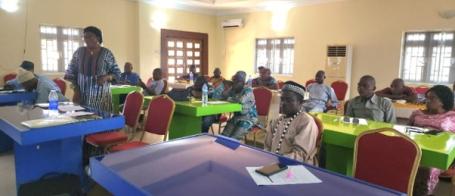
Meeting of a Joint Resource Management Committee
Share on